Can Walk Score Improve the Value of Your Home?

We previously reported that Belmont has the best “Walk Score” in Gaston County, (10/29/07), here is another take on the impact of sidewalks and walkable community values from Realty Times:

Just imagine, your real estate agent is showing you a print out from the Multiple Listing Service of a home you might want to buy. On the sheet is something you’ve never seen before.
“Our hope would be that eventually it’s something that is in the MLS, where it says ‘Two bedroom, two bathroom, 1,000 square feet, Walk Score of: 80,'” says Matt Lerner, co-developer of a website called Walk Score.
While the MLS doesn’t yet offer this feature, creating a Walk Score for a particular property is a concept that Lerner and a couple of other technology colleagues (Jesse Kocher and Mike Mathieu) developed after realizing that how walkable an area is, rates high for consumers.
“We got interested in the benefits of walkable neighborhoods partially due to a nonprofit in Seattle called the Sightline Institute which had done so much writing on all the benefits of walking,” says Lerner.
Lerner says some of the benefits were obvious, such as walking is good exercise and helps to reduce environmental pollution.
“But then there were some non-obvious benefits, such as walking is really good for communities because you’re out in your neighborhood, you’re talking to people, you’re meeting people. Walkable neighborhoods are also good for local businesses because, rather than driving to one place, you can stop and walk around and look at all the little stores. So it’s a good way to support local businesses and local culture too,” says Lerner.
So the developers set out to create a website that measures the walking score for home locations. Walk Score.com launched in the summer and in just four weeks got one million visitors wanting to know a property’s Walk Score. Using Google Maps and business listings, the site computes a Walk Score for any address in the United States and Canada. It bases the points assigned on the distance to local amenities and then averages the score. Then for the fun of it, visitors can compare their scores to that of famous locations and people such as Bill Gate’s house, Fenway Park or Jennifer Anniston and Brad Pitt’s (pre-divorce) home.
Lerner says that since the site launched they have received lots of emails from users saying that walkability is the number one priority they focus on when buying a house.
“I know in Seattle, for example, a lot of people work at Microsoft, which is in Redmond, so they commute to work but, for where they live, especially if they have kids or a family, having things they can walk to is really important and then for younger folks being able to walk to a bar or a coffee shop is important. Walk Score is a really simple way to see what’s in the neighborhood near the property you’re looking at,” says Lerner.
However, Walk Score doesn’t take into account things such as lakes or other roadblocks that might force someone to take a different route to get to the destination.
“What Walk Score does is fairly simple. We measure whether you can get to the types of businesses that consumers want and then we base a score on that,” says Lerner.
Lerner says creative real estate agents and homeowners are using it to help sell homes.
“One of the really fun things on the Internet has been that people are comparing their scores and bragging about them. A big, new condo in Seattle put up a huge Walk Score banner on the front that said Walk Score 100 and they used that banner as a marketing tool because they think that, for urban condos, walkability is one of the selling points,” says Lerner.
Buyers are using Walk Score to help determine which house better suits their needs.
“We’re seeing people actually comparing different properties and if a place gets a low Walk Score, someone can say, ‘Oh, wow I didn’t realize I couldn’t actually walk to the grocery store if I bought this house but if I buy this other one, I can walk to all these amenities,'” says Lerner.
Lerner says real estate agents see Walk Score as another way to help sell a property and, “in a down-real-estate market you need all the selling points you can get.”
Blessed be the Riverkeeper

Donna Lisenby, the Catawba riverkeeper, considered by many who live along the river basin to be a hero of sorts, has discovered and reported the Charlotte-Mecklenburg Utilities Department (CMUD) for “secret” wastewater releases.
WCNC and the Charlotte Observer are reporting that the FBI and EPA are investigating release practices by CMUD workers at the McAlpine Creek plant.
This water flows downstream and empties into Lake Wylie, where many of Belmont’s neighbors and friends live and play.
The reports, last night and this morning, coincide with a series of articles that the Observer is publishing on the Catawba River Chain of Lakes and its impact on the region.
We live in a fragile ecosystem that can easily be disrupted by weather patterns (drought, floods), development rates (run-off, sediment build up, pollutants entering the system), and over use (recreation access, draw down of water for municipal systems).
We are supportive of the Riverkeeper’s watchful eye, outspoken behaviors, and dogged determination.

Belmont picked as “Best Walkable Community in Gaston County”
Maybe the Gazette does like Belmont just a tad.
Front page above the fold article in Monday Gazette (10/29/07) briefly discusses what makes up a walkable community and which towns in Gaston are the best.
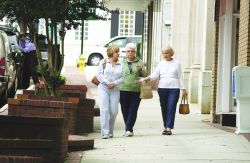
(Mike Hendsill – Gazette Photo)
Unfortunately, the Gazette writers chose the Hawthorne (Imperial Mill Village) neighborhood as an “established” neighborhood. It is in reality, a new community (built-out over the last 4 years) constructed over what was once an historic textile mill village.
And that is just part of the overall landscape.
Imperial Hawthorne (the forward slash deliberately left off), or now commonly referred to as the Great Wall of Keener, is indeed a very walkable community — for those who could afford to live there.
The more established, and mature neighborhoods, such as Reid, Davis Park, Mt. Pleasant, Cottonwood, and Adams Bluff, are even better suited for the tag as walkable communities within Belmont. Adams Bluff, however, being the only neighborhood with intersecting sidewalks.
Each are within the mile and a half of shopping and library. Each have low traffic flow which allows for some roadway walking, and the neighborhoods also have distinctive cultural diversity not generally found in the chosen neighborhood. Each are safe in relative terms.
We hope that the new in-town communities of Belmont Reserve (Belmont Hosiery), Eagle Park (Eagle Mill and Village), can and will be rated, because each of these will have internal sidewalks that interconnect with the existing city sidewalks and other neighborhoods.
Under the Traditional Neighborhood Development (TND) concept, and within the Neighborhood Preservation vision as outlined in the recent Comprehensive Land Use Plan, we encourage more developers and in-fill projects to highlight their plan for keeping Belmont a “Walkable Community”
 The Belmont Front Porch