Belmont picked as “Best Walkable Community in Gaston County”
Maybe the Gazette does like Belmont just a tad.
Front page above the fold article in Monday Gazette (10/29/07) briefly discusses what makes up a walkable community and which towns in Gaston are the best.
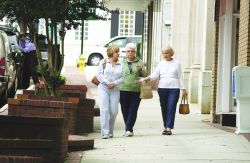
(Mike Hendsill – Gazette Photo)
Unfortunately, the Gazette writers chose the Hawthorne (Imperial Mill Village) neighborhood as an “established” neighborhood. It is in reality, a new community (built-out over the last 4 years) constructed over what was once an historic textile mill village.
And that is just part of the overall landscape.
Imperial Hawthorne (the forward slash deliberately left off), or now commonly referred to as the Great Wall of Keener, is indeed a very walkable community — for those who could afford to live there.
The more established, and mature neighborhoods, such as Reid, Davis Park, Mt. Pleasant, Cottonwood, and Adams Bluff, are even better suited for the tag as walkable communities within Belmont. Adams Bluff, however, being the only neighborhood with intersecting sidewalks.
Each are within the mile and a half of shopping and library. Each have low traffic flow which allows for some roadway walking, and the neighborhoods also have distinctive cultural diversity not generally found in the chosen neighborhood. Each are safe in relative terms.
We hope that the new in-town communities of Belmont Reserve (Belmont Hosiery), Eagle Park (Eagle Mill and Village), can and will be rated, because each of these will have internal sidewalks that interconnect with the existing city sidewalks and other neighborhoods.
Under the Traditional Neighborhood Development (TND) concept, and within the Neighborhood Preservation vision as outlined in the recent Comprehensive Land Use Plan, we encourage more developers and in-fill projects to highlight their plan for keeping Belmont a “Walkable Community”
8 candidates seek 3 open Belmont seats (Updated)
That’s It ? , that’s all the Observer could write? 
They are not “open”, they are contested.
Is this all that we are going to get from the City Council candidates this year?
You have to buy a copy of the Thursday (10/18)Observer to get more information. To be fair, there is a bit more information from the generic questionaire that was sent to all the candidates.
 Becky Burch: “…she would encourage the development of one shuttered textile mill to be converted into a nursing home…” and this helps the tax rate how?
“Burch said council members have the authority to ask developers to leave room for these areas, she said. They haven’t made that request yet though, she said.” WHY haven’t the council members made those requests – YET ?
We are not making this up – these are quotes from the Charlotte Observer.
 Irl Dixon: “While some candidates say they are concerned about high property taxes, Dixon said the tax rate dropped last year and he expects it to do the same in the future because of the development of high-end, waterfront homes”.
Does this give credence to the term “economic-genocide” that East-enders and South Point residents are concerned about? Push out the existing homes to build McMansions along the lake, reducing visibility and accessibility. This is a concern here in this community.
 Charlie Flowers: “If re-elected, Flowers said he will push for businesses to fill the now empty textile mills”.
Too Late Charlie ! Most of the mills have been torn down or are in the planning stages to be torn down. We cite the examples of the Belmont Hosiery plant – now, called Belmont Reserve. We cite the Imperial Mill – now vacant, and its mill village called Hawthorne. We cite the Acme – now the space for development. This site even had a viable park area that the city acutally refused to use (Woodlawn) in the late 1990’s. How about what once was the Belmont Dyers, now torn down with development plans for high-end housing. Even the cotton warehouse that Stowe Mills used over on Eagle Road (a perfectly good pre-cast concrete structure) was torn down to make way for the clear-cutting that is now known as Eagle Village. Not even going to discuss in any detail the tearing down of the Eagle Mill for $500,000 unsold homes across from Belmont Central.
 Ron Foulk: “…61-year-old political newcomer said council members have budget responsibility…”.
He’s not a newcomer — he has run for City council in at least 2 other elections. He also opposed the Amity Acres annexation into the city in the 1990’s. How can you trust someone who will be opposed to future annexations.
 Curtis Gaston: “He would favor a building moratorium, especially on large subdivisions.”
Once again, the Pittenger/Duke(Crescent) property is already under design – that’s over 1,000 acres of voluntarily annexed land. The city has had jurisdictional control for over ten years on this property and until it was sold to State Senator Pittenger, nothing was done to guide its development direction. Young Mr. Gaston needs to be more involved. He has promise but will he be committed in the long run?
 Martha Stowe: “…It [the land use plan] doesn’t prohibit developers, it just makes sure you’re working in tandem with developers,” she said. “As much development as we’re seeing in Belmont we’re going to have to do something other than what we have done…”
So, what are your plans and ideas?
Richard Turner: “…The recent land-use plan lacks teeth, Turner said, and developers have been able to build as they wanted using conditional zoning. He said the city needs a public facilities ordinance that wouldn’t allow growth beyond the city’s ability to service it…”
Dennis Boyce: “Did not respond”
We hope the BannerNews and the Gazette will expand these questions.
We find it amazing that wherever you see a Burch sign in a yard, there is a Flowers sign right next to it. If it looks like a ticket (signs), sounds like a ticket (identical votes on all issues before council), it’s probably a ticket. Vote for one, get 2. And we thought that the politics in Belmont was “non-partisan”.
Police see rash of car break-ins: 17 in Mount Holly, nine in Belmont
The Wal-Mart effect: Build it, and THEY will come !

Several years ago the political lines in the Belmont area were pretty well divided over growth issues. Type of Growth, Rate of Growth, Vision of Community, Sense of Belonging, and the kicker — Property Rights.
The mill community mentality, taken from the farms and hills of the early twentieth century learned young’uns the value of owning property if you “cud git ahold a sum”. Gaston County divided itself along the lines of the “Haves”, and the “Have Nots”.
The funny thing during the debate process (some called it “steamrolling”) was that nobody discussed the attendant collateral damage of big box development.
The collateral damage is the “flow-through” of increased traffic that these types of development brings to an area. Increased malicious mischief, vandalism, theft, and larceny are the damages.
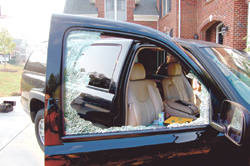
(Belmont Police photo published in Gazette)
This series is not just “kids with nothing to do”. It is not necessarily gang-related either.
Belmont Police Chief David James, always on the lookout for more money to increase the size of his force, commented on the potential of these issues in the original series of debates. Of course, his eye was on the development of his department — remember we built that grand new police department building on Chronicle Street with an eye on the future – (re: bigger than needed)
The article in the Gazette about the recent rash of auto break-ins, noted the neighborhoods where these occurred. “Build It, and They will come !” Works for both good and bad.
What can the community do? Well, besides call the police?
Be vigilant in your travels through town. Not paranoid, just observant.
With a lot of new people in the area, new homes, bigger dogs (which always seem to come with the type of folk who want to make some kind of “statement”), fancy-schmanzy cars, we need to try to reach out and make a community that is larger than the great walls that have been erected around several of the subdivisions.

Community Watch efforts are always good. The Neighborhood Preservation portion of the new Land Use Plan, can and should encourage these community efforts. Maybe Chief James would seek out funding opportunities to support Community Watch and Community Policing efforts. Another idea is to encourage police officers to live in the community. Many of our recent police recruits don’t live here, why should they care what they see as they are driving out of town at the end of their shift?
What efforts are being made to encourage/require public safety personnel to be active members of the community? Granted, there are a few who do live here, but as the force grows, what is being done?
The big deal a few years ago was to allow officers to drive their vehicle home — helps as a deterrent to crime. Problem is, We have never seen those cars in our various neighborhoods, unless there is a called-in issue.
Presence, vigilance, and connectivity help keep communities safe for everyone. Maybe the police department can use some of their funding from us to do more along those lines rather than buying more stuff…
 The Belmont Front Porch