More On Belmont’s Council Candidates
Two websites, Topix.com and GastonPolitics.com have had some interesting discussions about the Belmont City Council elections.
Many of the same commentary that has been found here, just repeated across the different blog sites. These are both in forum style and are in real-time whereas, this site has screened responses (called, moderation) according to the “rules of civility” found on another page here.
To review, the city council election has three incumbents and 5 challenging candidates for 3 slots on council. This is a 4-year position. The new council will be sworn in at the December meeting of the City Council.
How this election impacts the citizens of Belmont:
- Planning & Zoning concerns are on the table with a need for teeth in the regulations and ordinances
- Strategic Growth Planning is crucial to a patterned response to the needs of the existing community, which includes roads, water, utilities, etc.
- Quality of Life issues such as parks, workforce housing, and recreation are focal points
- The other issues that always present themselves, such as jobs, taxes, etc.
The Belmont Banner published a special on-line page, which surprised us here on the Front Porch. The BannerNews website must be in development stages… anyway, we are glad that this page was set up to be viewed by the public. Please review that page as well.
Encourage our neighbors and friends to get out on Tuesday to vote. With the paving project going on along Central Avenue, some people may be discouraged by the traffic issues in the morning or later in the day. Plan out your Tuesday to take time to vote.

Pictures of the Challenger Candidates:





Pictures of the Incumbents standing for Reelection:


YOUR CHOICE – YOUR FUTURE
Belmont picked as “Best Walkable Community in Gaston County”
Maybe the Gazette does like Belmont just a tad.
Front page above the fold article in Monday Gazette (10/29/07) briefly discusses what makes up a walkable community and which towns in Gaston are the best.
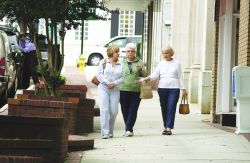
(Mike Hendsill – Gazette Photo)
Unfortunately, the Gazette writers chose the Hawthorne (Imperial Mill Village) neighborhood as an “established” neighborhood. It is in reality, a new community (built-out over the last 4 years) constructed over what was once an historic textile mill village.
And that is just part of the overall landscape.
Imperial Hawthorne (the forward slash deliberately left off), or now commonly referred to as the Great Wall of Keener, is indeed a very walkable community — for those who could afford to live there.
The more established, and mature neighborhoods, such as Reid, Davis Park, Mt. Pleasant, Cottonwood, and Adams Bluff, are even better suited for the tag as walkable communities within Belmont. Adams Bluff, however, being the only neighborhood with intersecting sidewalks.
Each are within the mile and a half of shopping and library. Each have low traffic flow which allows for some roadway walking, and the neighborhoods also have distinctive cultural diversity not generally found in the chosen neighborhood. Each are safe in relative terms.
We hope that the new in-town communities of Belmont Reserve (Belmont Hosiery), Eagle Park (Eagle Mill and Village), can and will be rated, because each of these will have internal sidewalks that interconnect with the existing city sidewalks and other neighborhoods.
Under the Traditional Neighborhood Development (TND) concept, and within the Neighborhood Preservation vision as outlined in the recent Comprehensive Land Use Plan, we encourage more developers and in-fill projects to highlight their plan for keeping Belmont a “Walkable Community”
Water Restrictions are Serious Business – Please Follow Instructions
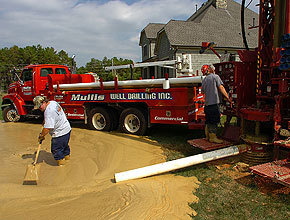
(Charlotte Observer Photo)
Imagine the arrogance of people who think that well water doesn’t affect a community’s ability to conserve its resources.
The city, towns, villages, and county tells you about Stage Restrictions — currently Stage 3, Mandatory — and what do people do? Contract with well-diggers to give themselves a “free source” of water. That recent article (October 11) in the Charlotte Observer, led to a series of letters to the editor that were critical of the practice, give us hope here on the Belmont Front Porch, that not all people are so ignorant or crazy, or both.
Here in Belmont, we have more than one neighborhood that purports to be using well-water for irrigation. This practice must stop !
There have been reports of frantic neighbors here in Gaston County calling insurance companies, well-drilling companies, and county officials about their “dried up wells”. Alledgedly, Gaston County staffers have told property owners that their only resolution is to “drill deeper”.
The Observer published a graphic that shows the impact of wells on the aquifer.
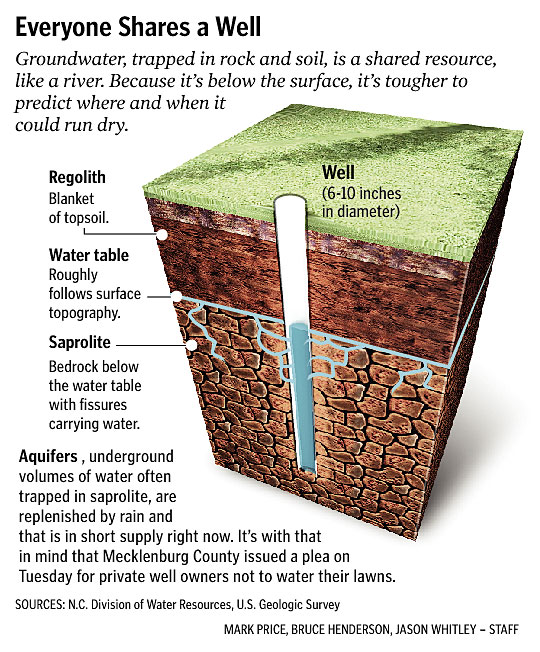
We have also published a portion of an article by the US Geological Survey about the relationship of Ground Water and Surface Water. The full article can be retrieved from this link: USGS
The Effect of Ground-Water Withdrawals on Surface Water
Withdrawing water from shallow aquifers that are directly connected to surface-water bodies can have a significant effect on the movement of water between these two water bodies. The effects of pumping a single well or a small group of wells on the hydrologic regime are local in scale. However, the effects of many wells withdrawing water from an aquifer over large areas may be regional in scale.
Withdrawing water from shallow aquifers for public and domestic water supply, irrigation, and industrial uses is widespread. Withdrawing water from shallow aquifers near surface-water bodies can diminish the available surface-water supply by capturing some of the ground-water flow that otherwise would have discharged to surface water or by inducing flow from surface water into the surrounding aquifer system. An analysis of the sources of water to a pumping well in a shallow aquifer that discharges to a stream is provided here to gain insight into how a pumping well can change the quantity and direction of flow between the shallow aquifer and the stream. Furthermore, changes in the direction of flow between the two water bodies can affect transport of contaminants associated with the moving water. Although a stream is used in the example, the results apply to all surface-water bodies, including lakes and wetlands.
A ground-water system under predevelopment conditions is in a state of dynamic equilibrium-for example, recharge at the water table is equal to ground-water discharge to a stream (Figure C-1A). Assume a well is installed and is pumped continually at a rate, Q1. After a new state of dynamic equilibrium is achieved, inflow to the ground-water system from recharge will equal outflow to the stream plus the withdrawal from the well. In this new equilibrium, some of the ground water that would have discharged to the stream is intercepted by the well, and a ground-water divide, which is a line separating directions of flow, is established locally between the well and the stream (Figure C-1B). If the well is pumped at a higher rate, Q2, at a later time a new equilibrium is reached. Under this condition, the ground-water divide between the well and the stream is no longer present and withdrawals from the well induce movement of water from the stream into the aquifer (Figure C-1C). Thus, pumpage reverses the hydrologic condition of the stream in this reach from a ground-water discharge feature to a ground-water recharge feature.
In the hydrologic system depicted in Figures C-1A and C-1B, the quality of the stream water generally will have little effect on the quality of the shallow ground water. However, in the case of the well pumping at the higher rate, Q2 (Figure C-1C), the quality of the stream water, which locally recharges the shallow aquifer, can affect the quality of ground water between the well and the stream as well as the quality of the ground water withdrawn from the well.
This hypothetical withdrawal of water from a shallow aquifer that discharges to a nearby surface-water body is a simplified but compelling illustration of the concept that ground water and surface water are one resource. In the long term, the quantity of ground water withdrawn is approximately equal to the reduction in streamflow that is potentially available to downstream users.
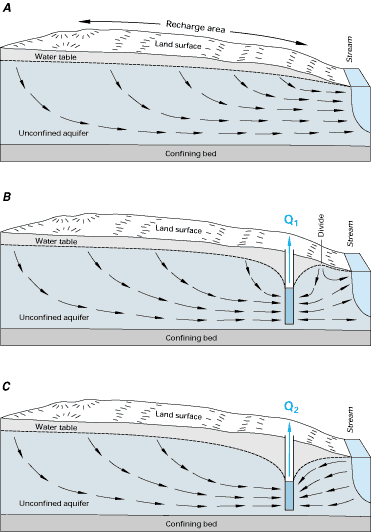
(USGS graphic)

 The Belmont Front Porch