Bad news: Carolinas cheated out of rain again

by Steve Lyttle, Charlotte.com
Forecasters say a combination of events will rob the Charlotte metro region and much of the Carolinas of what had been a strong chance for badly needed rain today.
Instead of a steady rain, we’ll be lucky to get a shower or two, they say.
But forecasters still hold out hope for Friday.
This is terrible news for the region, which is locked in one of the worst droughts in history. Charlotte is more than 13 inches below normal for rainfall this year, and mandatory water restrictions are in place across the area.
Today’s problem is a familiar story. It has happened at least four times since July.
A general area of low pressure has developed across the Southeast, and forecasters originally thought showery periods of rain would cross the region today. But instead, an area of strong thunderstorms is forming along the Gulf Coast, and that is robbing our region of moisture. In addition, the second center of the low pressure is moving to our north.
That leaves the Carolinas stuck in a relatively dry area between the two rainy areas.
It doesn’t mean we’ll be dry and sunny today. The atmosphere is very moist, and fog will be common in many area this morning. Skies will be mostly cloudy for the rest of the day, with high temperatures in the upper 70s and humid conditions.
On Friday, a frontal system will cross our area. Rodney Hinson, of the National Weather Service office in Greer, S.C., said that front is our next good chance for rainfall. Showers and thunderstorms are expected to develop along the front, with most of the precipitation expected to fall before 2 p.m.
Clearing is expected Friday evening and night, so the high school football games likely can be played without any problems.
Friday’s front will mean a pretty weekend.
Partly to mostly sunny skies are predicted, along with temperatures approaching 80 degrees both Saturday and Sunday.
“Stop the Watering of Lawns, Gardens – Period” – sez, Governor Easley
Speaking before the North Carolina League of Municipalities today, Governor Mike Easley has called for tighter water restrictions.
(WCNC photo)
Ok, City of Belmont, why is it ok for this?:

And This? :


(BFP photos – Eagle Road and Assembly Street)
After much deliberation, the editorial board of the the Front Porch has decided to post photos of homes and businesses who feel the need to live above their neighbors, and the local regulations.
10/16 Update: “Official: No need for mandatory water restrictions” (Salisbury, NC)
And they want to tap the Catawba for their water source?
R U SERIOUS ?
Water Restrictions are Serious Business – Please Follow Instructions
(Charlotte Observer Photo)
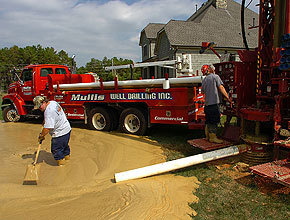
Imagine the arrogance of people who think that well water doesn’t affect a community’s ability to conserve its resources.
The city, towns, villages, and county tells you about Stage Restrictions — currently Stage 3, Mandatory — and what do people do? Contract with well-diggers to give themselves a “free source” of water. That recent article (October 11) in the Charlotte Observer, led to a series of letters to the editor that were critical of the practice, give us hope here on the Belmont Front Porch, that not all people are so ignorant or crazy, or both.
Here in Belmont, we have more than one neighborhood that purports to be using well-water for irrigation. This practice must stop !
There have been reports of frantic neighbors here in Gaston County calling insurance companies, well-drilling companies, and county officials about their “dried up wells”. Alledgedly, Gaston County staffers have told property owners that their only resolution is to “drill deeper”.
The Observer published a graphic that shows the impact of wells on the aquifer.
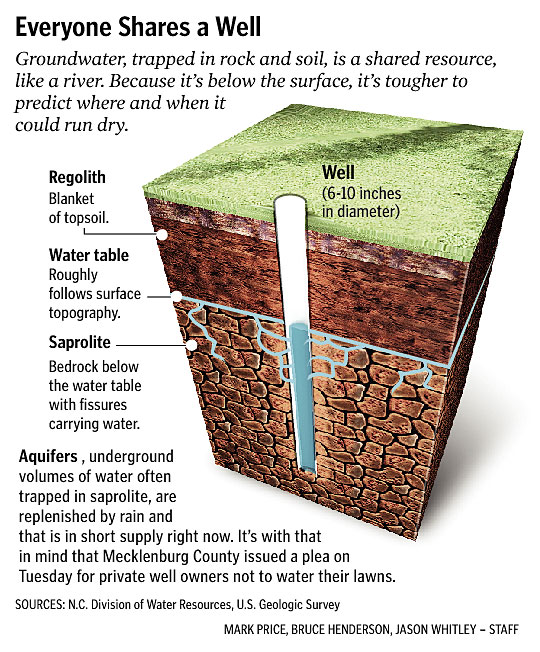
We have also published a portion of an article by the US Geological Survey about the relationship of Ground Water and Surface Water. The full article can be retrieved from this link: USGS
The Effect of Ground-Water Withdrawals on Surface Water
Withdrawing water from shallow aquifers that are directly connected to surface-water bodies can have a significant effect on the movement of water between these two water bodies. The effects of pumping a single well or a small group of wells on the hydrologic regime are local in scale. However, the effects of many wells withdrawing water from an aquifer over large areas may be regional in scale.
Withdrawing water from shallow aquifers for public and domestic water supply, irrigation, and industrial uses is widespread. Withdrawing water from shallow aquifers near surface-water bodies can diminish the available surface-water supply by capturing some of the ground-water flow that otherwise would have discharged to surface water or by inducing flow from surface water into the surrounding aquifer system. An analysis of the sources of water to a pumping well in a shallow aquifer that discharges to a stream is provided here to gain insight into how a pumping well can change the quantity and direction of flow between the shallow aquifer and the stream. Furthermore, changes in the direction of flow between the two water bodies can affect transport of contaminants associated with the moving water. Although a stream is used in the example, the results apply to all surface-water bodies, including lakes and wetlands.
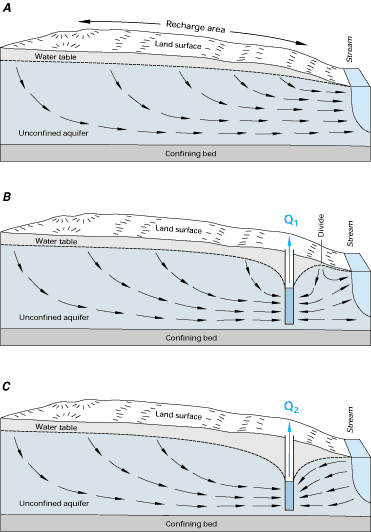
A ground-water system under predevelopment conditions is in a state of dynamic equilibrium-for example, recharge at the water table is equal to ground-water discharge to a stream (Figure C-1A). Assume a well is installed and is pumped continually at a rate, Q1. After a new state of dynamic equilibrium is achieved, inflow to the ground-water system from recharge will equal outflow to the stream plus the withdrawal from the well. In this new equilibrium, some of the ground water that would have discharged to the stream is intercepted by the well, and a ground-water divide, which is a line separating directions of flow, is established locally between the well and the stream (Figure C-1B). If the well is pumped at a higher rate, Q2, at a later time a new equilibrium is reached. Under this condition, the ground-water divide between the well and the stream is no longer present and withdrawals from the well induce movement of water from the stream into the aquifer (Figure C-1C). Thus, pumpage reverses the hydrologic condition of the stream in this reach from a ground-water discharge feature to a ground-water recharge feature.
In the hydrologic system depicted in Figures C-1A and C-1B, the quality of the stream water generally will have little effect on the quality of the shallow ground water. However, in the case of the well pumping at the higher rate, Q2 (Figure C-1C), the quality of the stream water, which locally recharges the shallow aquifer, can affect the quality of ground water between the well and the stream as well as the quality of the ground water withdrawn from the well.
This hypothetical withdrawal of water from a shallow aquifer that discharges to a nearby surface-water body is a simplified but compelling illustration of the concept that ground water and surface water are one resource. In the long term, the quantity of ground water withdrawn is approximately equal to the reduction in streamflow that is potentially available to downstream users.
(USGS graphic)

 The Belmont Front Porch