Water Restrictions are Serious Business – Please Follow Instructions
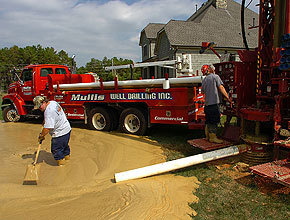
(Charlotte Observer Photo)
Imagine the arrogance of people who think that well water doesn’t affect a community’s ability to conserve its resources.
The city, towns, villages, and county tells you about Stage Restrictions — currently Stage 3, Mandatory — and what do people do? Contract with well-diggers to give themselves a “free source” of water. That recent article (October 11) in the Charlotte Observer, led to a series of letters to the editor that were critical of the practice, give us hope here on the Belmont Front Porch, that not all people are so ignorant or crazy, or both.
Here in Belmont, we have more than one neighborhood that purports to be using well-water for irrigation. This practice must stop !
There have been reports of frantic neighbors here in Gaston County calling insurance companies, well-drilling companies, and county officials about their “dried up wells”. Alledgedly, Gaston County staffers have told property owners that their only resolution is to “drill deeper”.
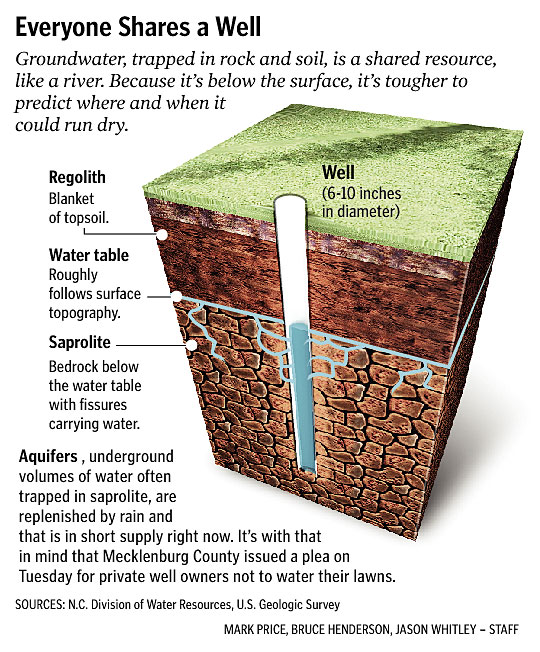
The Observer published a graphic that shows the impact of wells on the aquifer.
We have also published a portion of an article by the US Geological Survey about the relationship of Ground Water and Surface Water. The full article can be retrieved from this link: USGS
The Effect of Ground-Water Withdrawals on Surface Water
Withdrawing water from shallow aquifers that are directly connected to surface-water bodies can have a significant effect on the movement of water between these two water bodies. The effects of pumping a single well or a small group of wells on the hydrologic regime are local in scale. However, the effects of many wells withdrawing water from an aquifer over large areas may be regional in scale.
Withdrawing water from shallow aquifers for public and domestic water supply, irrigation, and industrial uses is widespread. Withdrawing water from shallow aquifers near surface-water bodies can diminish the available surface-water supply by capturing some of the ground-water flow that otherwise would have discharged to surface water or by inducing flow from surface water into the surrounding aquifer system. An analysis of the sources of water to a pumping well in a shallow aquifer that discharges to a stream is provided here to gain insight into how a pumping well can change the quantity and direction of flow between the shallow aquifer and the stream. Furthermore, changes in the direction of flow between the two water bodies can affect transport of contaminants associated with the moving water. Although a stream is used in the example, the results apply to all surface-water bodies, including lakes and wetlands.
A ground-water system under predevelopment conditions is in a state of dynamic equilibrium-for example, recharge at the water table is equal to ground-water discharge to a stream (Figure C-1A). Assume a well is installed and is pumped continually at a rate, Q1. After a new state of dynamic equilibrium is achieved, inflow to the ground-water system from recharge will equal outflow to the stream plus the withdrawal from the well. In this new equilibrium, some of the ground water that would have discharged to the stream is intercepted by the well, and a ground-water divide, which is a line separating directions of flow, is established locally between the well and the stream (Figure C-1B). If the well is pumped at a higher rate, Q2, at a later time a new equilibrium is reached. Under this condition, the ground-water divide between the well and the stream is no longer present and withdrawals from the well induce movement of water from the stream into the aquifer (Figure C-1C). Thus, pumpage reverses the hydrologic condition of the stream in this reach from a ground-water discharge feature to a ground-water recharge feature.
In the hydrologic system depicted in Figures C-1A and C-1B, the quality of the stream water generally will have little effect on the quality of the shallow ground water. However, in the case of the well pumping at the higher rate, Q2 (Figure C-1C), the quality of the stream water, which locally recharges the shallow aquifer, can affect the quality of ground water between the well and the stream as well as the quality of the ground water withdrawn from the well.
This hypothetical withdrawal of water from a shallow aquifer that discharges to a nearby surface-water body is a simplified but compelling illustration of the concept that ground water and surface water are one resource. In the long term, the quantity of ground water withdrawn is approximately equal to the reduction in streamflow that is potentially available to downstream users.
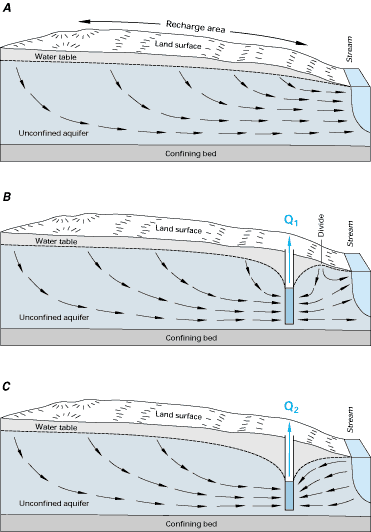
(USGS graphic)

The Facts on Belmont’s Parks and Recreation Bonds – Vote November 6
The City of Belmont sent out the September water bills and included an information flyer about the P & R Bond referendum on the November ballot.

The following is a transcript of the text of the flyer, our program does not allow us to replicate all the fancy bullet markings:
- The Belmont city Council voted unanimously to call for a $12 million Parks and Recreation Bond Referendum on November 6, 2007 to the the acquisition of land, the development of new recreation facilities, and the upgrading and development of existing parks.
- The referendum ask Belmont citizens to give the City permission to uses a special type of financing for the projects — General Obligation (GO) bonds.
- GO bonds are the least costly financing option available for these projects.
- The deadline to register for the November 6, 2007 general election is October 12, 2007.
- Belmont polling locations will be open from 6:30 a.m. to 7:30 p.m.

Parks and Recreation in our community offers our citizens the opportunity to use their leisure time in the parks, on the playing fields, and through special events.
The Parks & Recreation Comprehensive Master Plan from 2003 notes the following points regarding recreation needs in Belmont:
- The City will need to acquire land for and develop one community park (20-30 acres), develop one neighborhood park (10-15 acres), and develop five mini parks (1-2 acres) to accomodate both existing and anticipated needs by the year 2013.
- The community park should be intensely developed to provide multiple fields such as youth baseball, adult softball, football, and soccer. This park should be a high priority.
- The neighborhood park should be developed on City-owned land with passive recreational amenities such as trails, picnic areas, and shelters.
- A mini park should be developed on City-owned riverfront land as a passive use facility.
- Park sites should be acquired in the northern, eastern, and southern parts of the City to provide facilities for underserved areas.
- General obligation bonds shouldbe used as the major funding source for the proposed park acquisition and development activities.
FINANCIAL FACTS ON BELMONT’S PARKS AND RECREATION BONDS
-
The Belmont City Council has voted unanimously to place a $12,000,000 parks and recreation bond issue before Belmont voters on November 6, 2007
-
The projects included in the bond funding have been developed from a lengthy planning process that included strong citizen input.
-
All Belmont polling locations will be open from 6:30 a.m. to 7:30 p.m.
How will the City pay for the bond projects?
The City plans to borrow the money by selling general obligation (G.O.) bonds.
Why general obligation bonds?
G.O. bonds are the cheapest, fastest financing options available to the City for these projects. Because this type of bond pledges the city’s taxing authority as a commitment to repay the bonds, financial markets require less interest than other types of municipal borrowings.
How will the City pay back the bonds?
G.O. bonds can be paid back using revenue from any sources available to the City, including fees and taxes. Since the bond projects can be spread out over a number of years, the City has time to choose the best way to repay the debt. If approved, the bonds would be repaid over a 20-year period once issued.
How will the Parks and Recreation bonds affect the property tax rate?
The answer to this question depends on several factors: the growth in the tax base fro year to year, the dollar amount and time period in which the bonds are issued, and the availability of other revenue sources available to help pay the bond debt. If the entire $12,000,000 bond amount were to be issued at one time, it would require a tax rate of 10.6 cents to generate the revenue that would be needed to pay the annual debt costs. since it is not in the City’s plan to issue the bonds at one time but, instead, to do so over several years, the tax implications would be significantly less and would be reduced even further by the continued growth of the tax base.

Belmont City Council approves Annexation
(City of Belmont photo)
The City of Belmont grew larger after the September 4 council meeting approving a voluntary annexation request by Southland Resources.
34 additional acres just south of South Point High School will be incorporated into the city. Southland Resources plan to build as many as 118 homes on the narrow stretch of land now called South Point Village.
Apparently, one road will feed the new development, and the land will be clear-cut of trees to enable the site to be worked for higher density house placement. The current site is a mixture of pasture and woodland.
More importantly, this development has not yet received permission to build an outlet road through the South Ridge Development that lies just west of the high school campus. South Ridge has its only access road feeding onto an already congested Nixon Road.
The annexation was approved unanimously, with property rights advocates, Charlie Flowers and Charlie Martin, bringing the proposal to the table.
Our concern is two-fold on this annexation and proposed development. First is the road access. Under Traditional Neighborhood (TND) guidelines that the city attempts to live by, roads in developments will be interconnecting and have multiple outlets. The proposed development has neither. Second, a rush to approve clear-cutting in developments concerns us a a community. Developers like to get rid of as many trees, mature or not, to increase the density for the greenspace set asides. Of course trees can be planted.
However, non-native species of trees, ornamentals, and indiscriminate plantings affect the whole community over time.
Lifelong resident and retired Duke Power employee, George Hall, pointed out a concern over the massive clear-cutting that is taking place in the Belmont area. He noted that several older developments, Glenmere and Fallingbrook, incorporated the mature trees into their plans. Of course these developments were also 1-acre lots. The new developments are cramming 3 sometimes 4, and in rare occasions 5 lots in an acre of land.
The Hawthorne project that was recently completed in the old Imperial Mill Village area, did a very good job in the replantings. The developer, Bob Clay, representing Pharr Yarns, replanted oaks, maples, poplars, birches, and several versions of evergreens.
We need more people to participate in “watchdog” type of activities as developments are brought to the council for approval. This is a development happy group that only looks out after the city coffers for the growing city employee population, not the taxpayer.
 The Belmont Front Porch