Belmont tightens water restrictions
Belmont is tightening some of its mandatory water use restrictions that resulted from the recent Stage 2 declaration.
Effective immediately, the watering of lawns is prohibited at all times. This includes not only the continued prohibition against any type of irrigation or sprinkler system, as banned under Stage 2, but now includes lawn watering with the use of a hand-held hose.
The watering of plants, shrubs, or trees may continue using a hand-held hose with a spring-loaded nozzle on the schedule of days and times specified in the Stage 2 regulations. Also banned are ornamental fountains.
Civil penalties for violating any of the mandatory water use rules will remain as for Stage 2: up to $100 for residential customers and $500 for commercial or industrial customers, with possible disconnection for continued violations.
The actions are in anticipation of a Stage 3 water restriction, which is likely to occur within the next few weeks.
For more information, call the Belmont City Hall at 704-825-5586.
Does this mean the fountain at Stowe Park too?
What about the football field and baseball field at South Point?
Does that mean the folks out at Belle Meade and Reflection Pointe have to stop watering?
What if we all just put out signs that say, “Well Water Used For Irrigation”, does that count?
How water restrictions are decided:
Wondering who and what decides local water restrictions?
At their heart is Duke Energy, which manages the Catawba River reservoirs under a federal hydroelectric license that expires in 2008. In negotiating terms of a new license, Duke created a drought-response plan that’s getting its first test.
How it works
The plan is designed to stretch water supplies during a dry spell.Twenty-four local governments, including Charlotte-Mecklenburg Utilities, belong to an advisory group that puts the plan into action. Each enacts its own water restrictions based on shared conservation goals.
Duke monitors three conditions: lake levels, for how much water is in its reservoirs; stream flows that feed the lakes; and the U.S. Drought Monitor.
As the drought drags on
The plan sets trigger points to respond to conditions.
At Stage 1, declared July 30, Duke reduced the amount of water released from its dams and closed some boat ramps as lake levels fell. Local water agencies asked customers to reduce water demand 3 percent to 5 percent.
At Stage 2, in effect Aug. 27, Duke further cut water releases, shutting down most of its hydro plants. Local governments set mandatory restrictions with a conservation goal of 5 percent to 10 percent.
More cuts to come?
Stage 3 awaits, probably later in October if no rain falls.Duke would further lower lake levels, especially at Lakes James and Norman, which hold most of the system’s water. Lake James could fall to as much as 15 feet below full pond in October. The winter months could take it still lower.
Municipal water users could face more restrictions to meet a Stage 3 conservation goal of 10 percent to 20 percent. The watering ban last week by Charlotte-Mecklenburg Utilities and several other cities is as harsh as it’s likely to get for homeowners. Charlotte-Mecklenburg says it would turn to cuts among large industrial and commercial customers.
Stage 4 would further clamp down, with a goal of cutting water use 20 percent to 30 percent.
If rain doesn’t come
The Catawba won’t run out of water. But lake levels could drop to the point that intakes for power plants, municipalities and industries can’t pump water.
The region’s conservation efforts are trying to prevent that.
At Lake Norman, for instance, the critical intake-covering level is 10 feet below full pond. The lake is now 6.5 feet below full. Since a lot of water depth is under the intake, the lake could be left with billions of gallons — all out of reach.
Police see rash of car break-ins: 17 in Mount Holly, nine in Belmont
The Wal-Mart effect: Build it, and THEY will come !

Several years ago the political lines in the Belmont area were pretty well divided over growth issues. Type of Growth, Rate of Growth, Vision of Community, Sense of Belonging, and the kicker — Property Rights.
The mill community mentality, taken from the farms and hills of the early twentieth century learned young’uns the value of owning property if you “cud git ahold a sum”. Gaston County divided itself along the lines of the “Haves”, and the “Have Nots”.
The funny thing during the debate process (some called it “steamrolling”) was that nobody discussed the attendant collateral damage of big box development.
The collateral damage is the “flow-through” of increased traffic that these types of development brings to an area. Increased malicious mischief, vandalism, theft, and larceny are the damages.
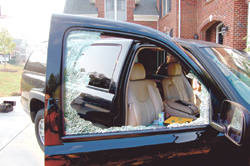
(Belmont Police photo published in Gazette)
This series is not just “kids with nothing to do”. It is not necessarily gang-related either.
Belmont Police Chief David James, always on the lookout for more money to increase the size of his force, commented on the potential of these issues in the original series of debates. Of course, his eye was on the development of his department — remember we built that grand new police department building on Chronicle Street with an eye on the future – (re: bigger than needed)
The article in the Gazette about the recent rash of auto break-ins, noted the neighborhoods where these occurred. “Build It, and They will come !” Works for both good and bad.
What can the community do? Well, besides call the police?
Be vigilant in your travels through town. Not paranoid, just observant.
With a lot of new people in the area, new homes, bigger dogs (which always seem to come with the type of folk who want to make some kind of “statement”), fancy-schmanzy cars, we need to try to reach out and make a community that is larger than the great walls that have been erected around several of the subdivisions.

Community Watch efforts are always good. The Neighborhood Preservation portion of the new Land Use Plan, can and should encourage these community efforts. Maybe Chief James would seek out funding opportunities to support Community Watch and Community Policing efforts. Another idea is to encourage police officers to live in the community. Many of our recent police recruits don’t live here, why should they care what they see as they are driving out of town at the end of their shift?
What efforts are being made to encourage/require public safety personnel to be active members of the community? Granted, there are a few who do live here, but as the force grows, what is being done?
The big deal a few years ago was to allow officers to drive their vehicle home — helps as a deterrent to crime. Problem is, We have never seen those cars in our various neighborhoods, unless there is a called-in issue.
Presence, vigilance, and connectivity help keep communities safe for everyone. Maybe the police department can use some of their funding from us to do more along those lines rather than buying more stuff…
All Aboard! Stowe Park committee hopes to get train back on track
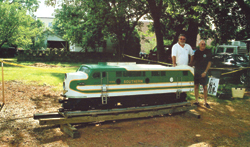
(Gazette Photo- courtesy of Belmont Historical Society)
Anybody who grew up in Belmont has a favorite memory of Stowe Park. Who can’t remember riding the Ferris wheel and being stopped at the very top? Or the big colored lights that hung over the walkways from Main Street down into the park? Watching movies at the amphitheater or dancing on the dance floor? Or being so small and looking up at the big sliding board?
But perhaps your most vivid recollection is the train that circled the upper part of the park and went through the tunnel.
The Belmont historical Society has recently been given the train and has formed a Stowe Park Train restoration committee. The members of the committee plan to paint the train its original colors and store it at its home on Catawba Street. Plans also include restoring one of the passenger cars.
The storage building is on the back of the property of the Cultural and Heritage Learning Center. Citizens are asked to bring any old pictures of Stowe Park to the center to have copies made. The train was recently on exhibit at the Summer Fest at Stowe Park.
Donations are being accepted for the restoration and are tax deductible. For more information, call (704) 825-4848.
 The Belmont Front Porch