Water Restrictions are Serious Business – Please Follow Instructions
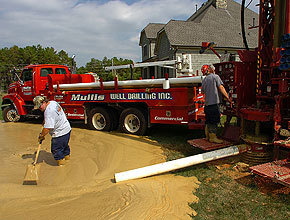
(Charlotte Observer Photo)
Imagine the arrogance of people who think that well water doesn’t affect a community’s ability to conserve its resources.
The city, towns, villages, and county tells you about Stage Restrictions — currently Stage 3, Mandatory — and what do people do? Contract with well-diggers to give themselves a “free source” of water. That recent article (October 11) in the Charlotte Observer, led to a series of letters to the editor that were critical of the practice, give us hope here on the Belmont Front Porch, that not all people are so ignorant or crazy, or both.
Here in Belmont, we have more than one neighborhood that purports to be using well-water for irrigation. This practice must stop !
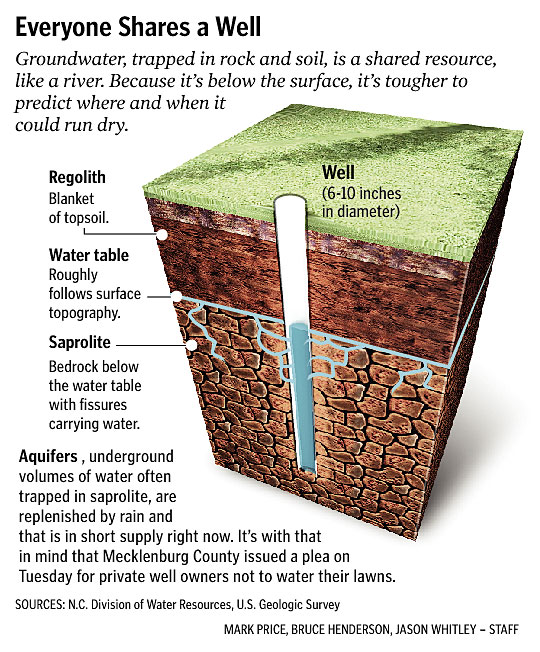
There have been reports of frantic neighbors here in Gaston County calling insurance companies, well-drilling companies, and county officials about their “dried up wells”. Alledgedly, Gaston County staffers have told property owners that their only resolution is to “drill deeper”.
The Observer published a graphic that shows the impact of wells on the aquifer.
We have also published a portion of an article by the US Geological Survey about the relationship of Ground Water and Surface Water. The full article can be retrieved from this link: USGS
The Effect of Ground-Water Withdrawals on Surface Water
Withdrawing water from shallow aquifers that are directly connected to surface-water bodies can have a significant effect on the movement of water between these two water bodies. The effects of pumping a single well or a small group of wells on the hydrologic regime are local in scale. However, the effects of many wells withdrawing water from an aquifer over large areas may be regional in scale.
Withdrawing water from shallow aquifers for public and domestic water supply, irrigation, and industrial uses is widespread. Withdrawing water from shallow aquifers near surface-water bodies can diminish the available surface-water supply by capturing some of the ground-water flow that otherwise would have discharged to surface water or by inducing flow from surface water into the surrounding aquifer system. An analysis of the sources of water to a pumping well in a shallow aquifer that discharges to a stream is provided here to gain insight into how a pumping well can change the quantity and direction of flow between the shallow aquifer and the stream. Furthermore, changes in the direction of flow between the two water bodies can affect transport of contaminants associated with the moving water. Although a stream is used in the example, the results apply to all surface-water bodies, including lakes and wetlands.
A ground-water system under predevelopment conditions is in a state of dynamic equilibrium-for example, recharge at the water table is equal to ground-water discharge to a stream (Figure C-1A). Assume a well is installed and is pumped continually at a rate, Q1. After a new state of dynamic equilibrium is achieved, inflow to the ground-water system from recharge will equal outflow to the stream plus the withdrawal from the well. In this new equilibrium, some of the ground water that would have discharged to the stream is intercepted by the well, and a ground-water divide, which is a line separating directions of flow, is established locally between the well and the stream (Figure C-1B). If the well is pumped at a higher rate, Q2, at a later time a new equilibrium is reached. Under this condition, the ground-water divide between the well and the stream is no longer present and withdrawals from the well induce movement of water from the stream into the aquifer (Figure C-1C). Thus, pumpage reverses the hydrologic condition of the stream in this reach from a ground-water discharge feature to a ground-water recharge feature.
In the hydrologic system depicted in Figures C-1A and C-1B, the quality of the stream water generally will have little effect on the quality of the shallow ground water. However, in the case of the well pumping at the higher rate, Q2 (Figure C-1C), the quality of the stream water, which locally recharges the shallow aquifer, can affect the quality of ground water between the well and the stream as well as the quality of the ground water withdrawn from the well.
This hypothetical withdrawal of water from a shallow aquifer that discharges to a nearby surface-water body is a simplified but compelling illustration of the concept that ground water and surface water are one resource. In the long term, the quantity of ground water withdrawn is approximately equal to the reduction in streamflow that is potentially available to downstream users.
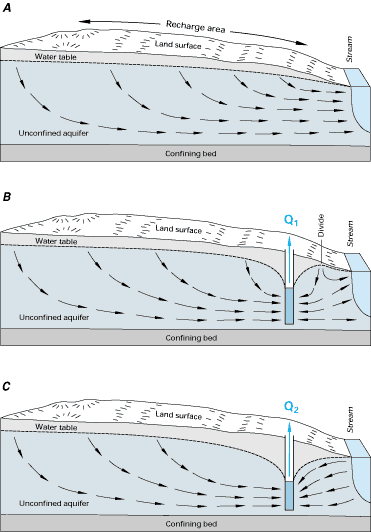
(USGS graphic)

Towns getting tougher on water violators
No legitimate reason to be overusing a resource in a time of crisis. There is no birthright to water a lawn or wash your car. Well, some will try to make a case for it anyway.

Kevin Siers, a political cartoonist for the Charlotte Observer holds a “write a caption” constest each week. This is last week’s cartoon and winning caption:
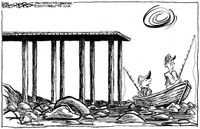
“Fishing in Lake Norman is great, but I only CMUD!” — William Owens of Marvin, NC
Weather is also not expected to break anytime soon. Hot and Dry – makes for raking leaves a lot easier.

Duke: No one in region should be watering lawns
Area municipalities that aren’t already banning lawn watering should do so, because drought conditions are worsening, Duke Energy announced Thursday.
Duke declared a Stage 3 low inflow condition for the Catawba-Wateree River Basin, which affects municipalities surrounding Charlotte, including Gastonia, Lincolnton, Statesville and others.
Mecklenburg County became the first in the area to implement Stage 3 water restrictions last week, prohibiting all lawn watering. Duke wants other areas, which may be under lesser restrictions, to follow suit.
Duke says no local government should be allowing people to water their grass, but implementation and enforcement of those restrictions is up to each municipality.
More than half of North Carolina is now is the most severe category of drought.
A weekly report from the U.S. Drought Monitor says that 55 of the state’s 100 counties are now experiencing an “exceptional” drought. In all, 47 counties moved to “exceptional” from “extreme” drought conditions in the latest report.
Among those now listed in the worst category are the Triangle area counties of Wake, Johnston, Durham and Orange.
In the rest of the state, 31 counties are still in extreme drought, while 14 have moderate to severe drought conditions.
(The Associated Press contributed to this report.)
Video Link:WCNC Report, 10-3-2007
The following article is reporinted from the Charlotte Observer:
10 ways you can cope with our dry weather
NANCY BRACHEY
Garden Editor, Charlotte Observer
We’re gardening in a time of drought. It’s something we’ve experienced a lot over the past decade — including one long stretch lasting five years. For the first time, lawn watering is now prohibited in Mecklenburg County and elsewhere in the Piedmont. And we’re being encouraged to conserve water in a lot of ways, including gardening. So, we’ll have to learn to live with dry times and embrace the techniques and strategies that make for smarter gardening in a drought. Here are some:
1.Embrace native plants. They tolerate dry weather. Some of our best plants: eastern redbud, purple coneflower, eastern columbine and black-eyed Susans (below). For an excellent guide to landscaping with native trees, shrubs and perennials: www.ncwildflower.org.
2.Plan your landscape with water conservation in mind. Learn the water needs of plants before you buy them. For example, impatiens are thirsty plants for summer bedding, zinnias are not. Group plants that require steady watering together so you don’t water ones that don’t need it, such as many kinds of herbs and fuzzy-leaved perennials such as lambs ears.
3.Commit yourself to excellent bed preparation for your shrubs, flowers and vegetables this fall and next spring. Use compost and other organic materials to lighten clay soil and help it hold moisture without becoming soggy.
4. Use mulch, but not too much. Mulch your trees, shrubs and flower beds with pine needles, compost, leaf litter or finely shredded bark to conserve moisture. Mulch should be 2 to 4 inches deep. Don’t put mulch against tree trunks.
5.Create natural areas in places where it is difficult to grow grass, even under normal weather conditions. This includes under the canopy of large shade trees.
6.Don’t let clean water go down the drain. If you wait for the water to warm up before stepping in the shower, pop in a plastic bucket to catch this cool water. Apply the same technique in your kitchen with a large pitcher set under the faucet to catch any clean water that would otherwise go down the drain. Use it on your houseplants and container gardens.
7.Use ground covers. There are lots to choose from, including ajuga (below), hardy ferns, hellebores, creeping phlox and many more for sun or shade.
8.Use devices that drip, seep or ooze water in shrub and flower beds and vegetable gardens, where allowed, such as in Mecklenburg. Place these little hoses under mulch. Water will drip onto the root zones, and not be wasted by runoff. Best-known ones are called soaker hoses. Mulch reduces evaporation.
9.Get a rain barrel. This will capture rainfall (when it does fall) via a downspout directed into the barrel. Attach your hose to a faucet near the bottom. Barrels are sold widely. To see how they work: www.moriver.org/programs.html or, in greater detail, www.cwp.org/Community_Watersheds/brochure.pdf
10.Love your watering can. You’ll be more likely to use only what you need. Use it to water containers and newly planted shrubs and trees. You can put water on slowly, avoid runoff and let it flow exactly where you want it. Hand-watering is still allowed most places.
AND WHAT ABOUT THE GRASS?
• New restrictions issued this week prohibit grass watering in Mecklenburg County and other places. Meanwhile, you can still water flowers, shrubs and trees and containers.
• So, should you be worried about the state of your lawn? If your fescue lawn is in reasonably good shape, it should recover as the weather cools and some rainfall arrives to perk it up. But don’t expect the rapid and robust growth you would see with steady rainfall or regular irrigation.
• What next? Just hold tight. The weather may be good enough for lawn renewal work, such as overseeding, in late October and November. And if necessary, we’ll just wait until late February or early March.
Nancy Brachey’s column, Ask Nancy, will focus on drought questions in coming weeks. Send yours to nbrachey@charlotteobserver.com or call (704) 375-4892.
 The Belmont Front Porch